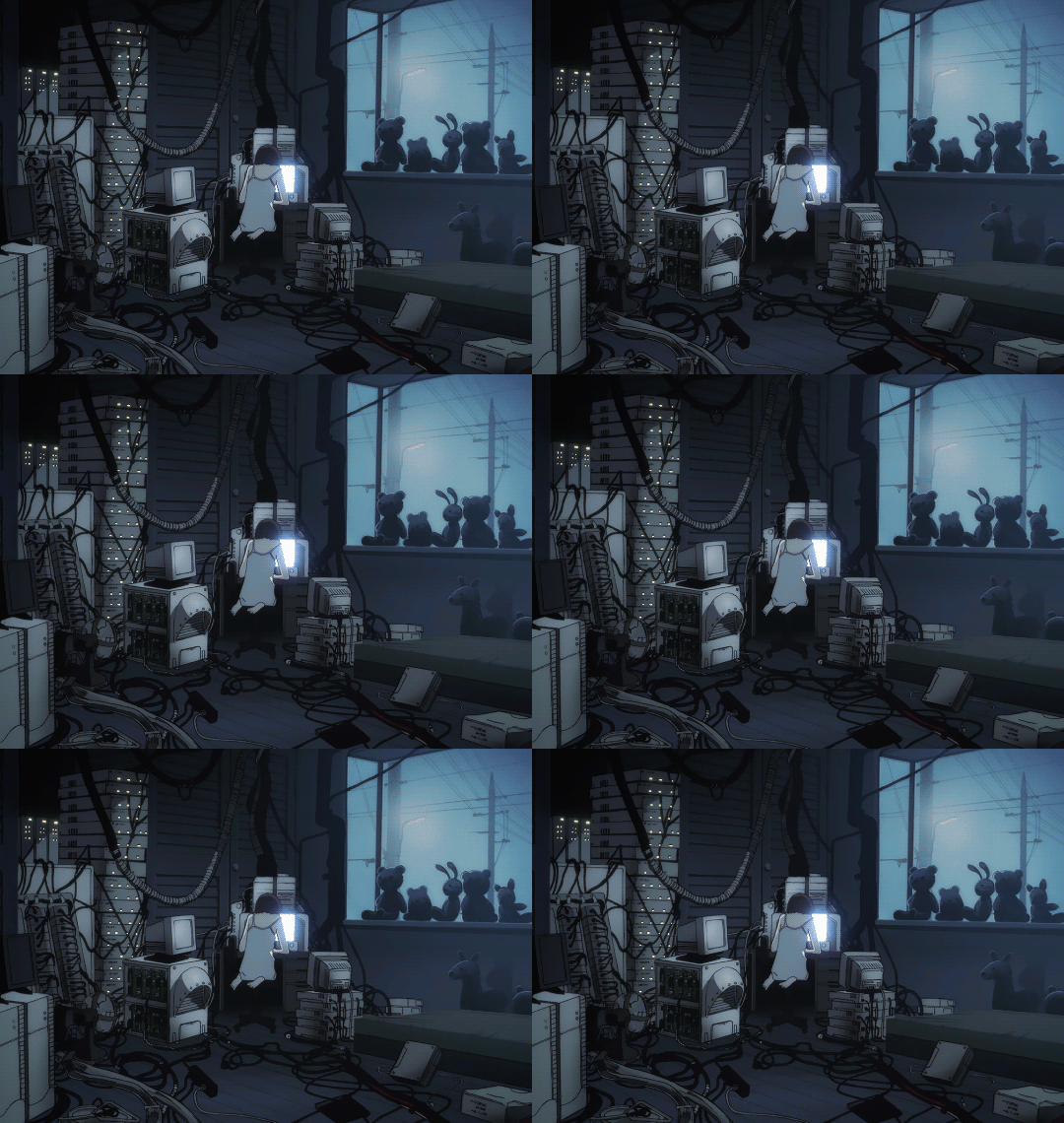


"At least now you’re free to become anything you want."
"...No, I guess you were actually free all along."
"...Perhaps."
It can be said that the 1998 anime Serial Experiments Lain has been prescient about many aspects about our current reality in 2026—it resonates widely even beyond the show's cult following. Aesthetic, as they say. But where does it come from?
The series follows Lain, a Japanese teenager in suburban Tokyo, who receives an email from a classmate who committed suicide a week earlier: "I only abandoned my flesh. I can tell that I'm still alive… God is here."
The first thing you notice? The hum of electric wires.
The show's atmosphere is hallucinatory, hypnagogic—other characters recall a Lain she doesn't recognize. Neither you nor Lain can guess what is actually happening. The Wired, this world's version of the internet, slowly bleeds into mundane life. Lain eventually learns that she's a program designed to bridge the Wired and reality.
By the end, Lain "ascends" to become the Wired's "goddess"—but her apotheosis is strange. She erases all memory of herself, empties her 'self' out. She doesn't choose between worlds or merge them. Instead, Lain becomes the liminal infrastructure that enables both to exist—everywhere and nowhere, invisible.
She has become that hum of electrical wires that one would hear throughout the show.
"I promise you I'll always be right here. I'm right next to you, forever."
This kind of figure is not new. Threshold-walkers, psychopomps, the between-dwellers. Siberian shamans, Amazonian ayahuasceros, Korean mudang, Shinto kannushi, Filipino babaylan. What did these figures[1]These traditions that I have cited are NOT expressions of the same underlying truth. The cosmological, sociological and political substrates through which each emerged are so radically different they might as well be different universes. The mudang operates within a specific Korean spirit world with its own hierarchies, relationships and textures. The babaylan operates within precolonial Filipino cosmologies that were violently disrupted and absorbed by Spanish Catholicism, which then morphed into a porous syncretism. The kannushi operate within Shinto frameworks of kami and ritual purity. What is noted here is the structural resonance across different universes, not convergence on the same cosmological truth. They echo each other but from different frequencies. They were not born from the same protocol. all have in common? They shared a common technology—autovesselization—the ability to make themselves empty vessels.
The Christian tradition recognizes this movement: sareq[2]Sareq (ܣܰܪܶܩ) is the Syriac verb used in the Peshitta—the classical Bible of the ancient Syriac Christian tradition—at Philippians 2:7, which is where it renders the Greek ekenōsen (ἐκένωσεν) as: "...but emptied himself and took the form of a servant, and became in the likeness of humanity. (ܐܶܠܳܐ ܢܰܦ݂ܫܶܗ ܣܰܪܶܩ ܘܰܕ݂ܡܽܘܬ݂ܳܐ ܕ݁ܥܰܒ݂ܕ݁ܳܐ ܢܣܰܒ݂ ܘܰܗܘܳܐ ܒ݁ܰܕ݂ܡܽܘܬ݂ܳܐ ܕ݁ܰܒ݂ܢܰܝܢܳܫܳܐ ܘܒ݂ܶܐܣܟ݁ܺܡܳܐ ܐܶܫܬ݁ܟ݂ܰܚ ܐܰܝܟ݂ ܒ݁ܰܪܢܳܫܳܐ) [Ellā nafsheh sareq, wadmuta d'avda nsav, wahwa badmuta davnaynasha, wv'eskima eshtkaḥ ayk barnasha.]" The Greek term became kenosis—a doctrine in Western and Byzantine theology. Syriac is preferred here because Syriac Christianity, rooted in an Aramaic-speaking milieu, preserved a bodily and verbal quality less thoroughly shaped by the Neoplatonic frameworks that shaped the Greek tradition—keeping the act as a verb, not a doctrine., self-emptying not as metaphysical category but as bodily event.
In this state, they are able to intercede between worlds, are able to speak to spirits and entities of other worlds, are able to make one intelligible to the other—a protocol made flesh.[3]"And the Word was made flesh, and dwelt among us, (and we beheld his glory, the glory as of the only begotten of the Father,) full of grace and truth." (John 1:14, KJV)
ܘܡܠܬܐ ܒܣܪܐ ܗܘܐ ܘܐܓܢ ܒܢ ܘܚܙܝܢ ܫܘܒܚܗ ܫܘܒܚܐ ܐܝܟ ܕܝܚܝܕܝܐ ܕܡܢ ܐܒܐ ܕܡܠܐ ܛܝܒܘܬܐ ܘܩܘܫܬܐ (W-melta basra hwa, w-agen ban, w-ḥzayn shuvḥeh — shuvḥa ayk d-yeḥidaya d-men ava, d-male tayvuta w-kushta.) (John 1:14, Peshitta)
The shaman would enter trance states through ritual—chanting, dancing, invoking—until the 'self' dissolves. In this emptied state, spirits and other worlds can speak through them. They make themselves nobody so something else can be present. The babaylan becomes a living interface through which the human realm communicates with the dead, calls rain and translates the language of rocks.
The kannushi autovesselizes into ritual technology—the body becomes an interface through trance or other mental states. Lain autovesselizes into computational technology—her being becomes protocol. Both are in the same liminal position. They are a membrane—permeable, translating, keeping worlds in contact.
We join thirty spokes to the hub of a wheel,
yet it's the center hole that drives the chariot.
We shape clay to birth a vessel,
yet it's the hollow within that makes it useful.
We chisel doors and windows to construct a room,
yet it's the inner space that makes it livable.
Thus do we create what is
to use what is not.
We live decades past Lain's time. The real world and the internet have long since overlapped—not merged, but layered—it coexists with the physical world with its own logic, and its own kind of inhabitants. It's another ecological system—much like the realm of rocks or dreams are. Still we speak of the digital as a fundamental Other, an object separate from us to be escaped to and escaped from. We speak of "touching grass" as if we don't see grass on TikTok or Instagram Reels—as if our computers haven't molded to our proprioception.[4]"I think one of the things that really separates us from the high primates is that we're tool builders. I read a study that measured the efficiency of locomotion for various species on the planet. The condor used the least energy to move a kilometer. And, humans came in with a rather unimpressive showing, about a third of the way down the list. It was not too proud a showing for the crown of creation. So, that didn't look so good. But, then somebody at Scientific American had the insight to test the efficiency of locomotion for a man on a bicycle. And, a man on a bicycle, a human on a bicycle, blew the condor away, completely off the top of the charts. And that's what a computer is to me. What a computer is to me is it's the most remarkable tool that we've ever come up with, and it's the equivalent of a bicycle for our minds." —Steve Jobs, from "Memory & Imagination: New Pathways to the Library of Congress" (1990) https://youtu.be/6kalMB8jDnY?si=pl-v5EadrdMcogMb&t=209
The babaylan does not even conceive of this as a problem to solve but a position to inhabit.
"No matter where you are, everyone's connected."
///END TRANSMISSION///